
Commercial Roofing
Why Commercial Roofs Leak at Parapets and Drains
Most commercial roof leaks start where the roof stops being flat, at parapet walls, drains, curbs and penetrations. The field of the membrane is rarely the culprit. Here is why those edges fail, what each leak looks like inside, and what we check before anyone quotes a fix.
- ★ 4.9 on Google · 69 reviews
- Same-day or next-day bookings
- Based in Van Nuys, CA
Published and updated November 3, 2026 · By the Clear Shield Roofers team, Van Nuys, CA
On this page
- Where a commercial flat roof leaks first
- Why parapet walls let water in
- Roof drains, scuppers and ponded water
- How we trace a commercial leak before quoting
- Do you need a moisture survey on a leaking commercial roof?
- What working roofers say about parapet and drain repairs
- What changes the cost of a commercial leak repair
- Repair a detail or replace the membrane
- Next step for a leaking commercial roof
- Common questions
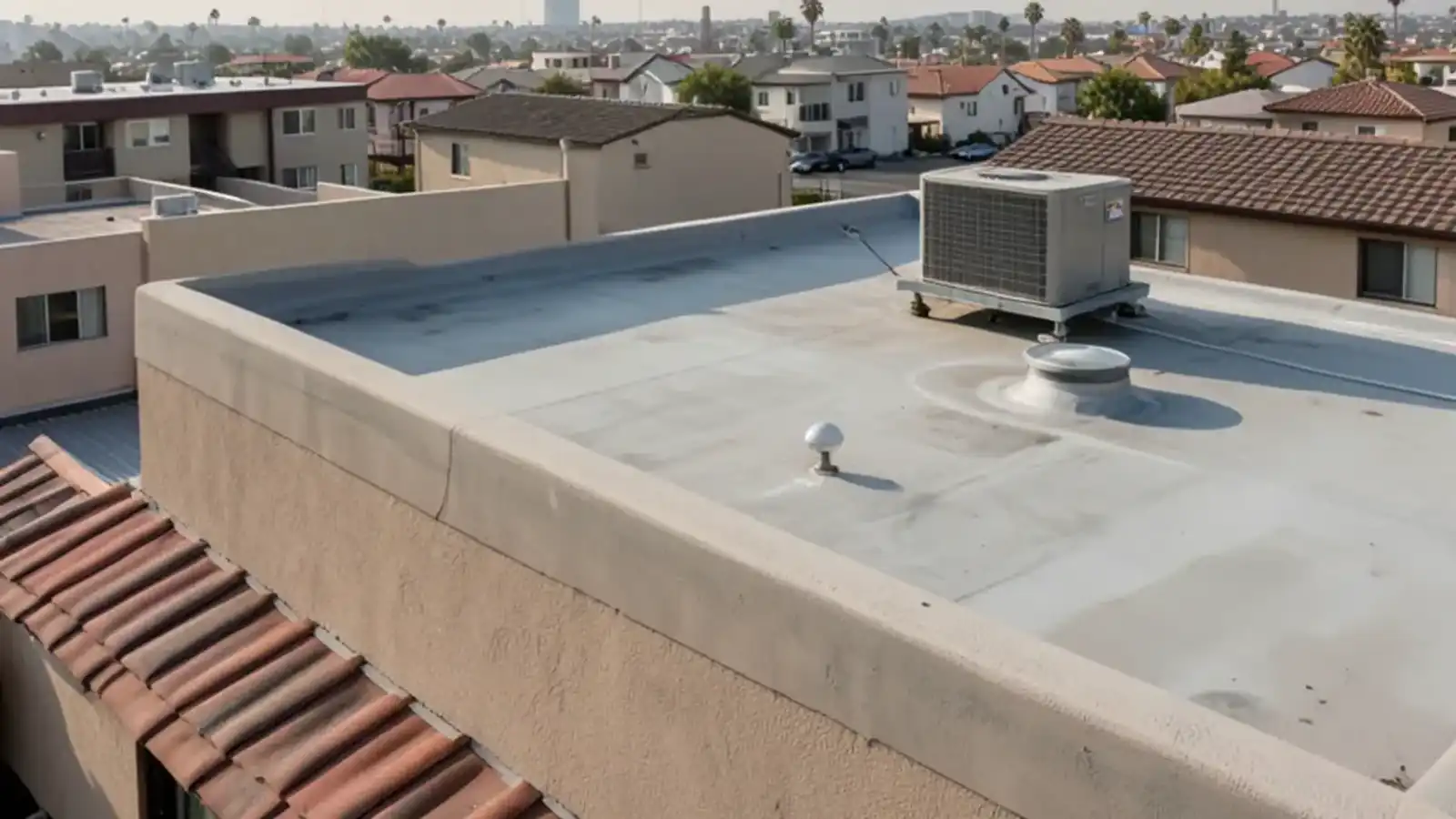
A leak that shows up on a tenant's ceiling is almost never a hole in the middle of the roof. Water finds the edges first. Parapets, drains, curbs and pipe penetrations are where one material stops and another begins, and that is where a commercial flat roof gives up.
Knowing the usual suspects saves money. A property manager who can say "it is probably the wall flashing near the northeast corner" gets a faster repair than one who says "the ceiling is wet." Our commercial roof repair work follows the same logic, and this guide covers the commercial roofing basics behind it.
Where a commercial flat roof leaks first
Start with the transitions. The flat field of a membrane has no joints to speak of beyond its seams, so water has few ways in. Every edge, curb and pipe adds a detail, and details are where installation shortcuts and years of sun show up.
| Where water gets in | What fails | What it looks like inside |
|---|---|---|
| Top of a parapet wall | Open coping joints, cracked cap | Stains down an exterior wall or at a window head |
| Base of a parapet wall | Lifted wall flashing, dried sealant | Stain along the ceiling edge by that wall |
| Roof drain | Clog, cracked bowl, failed clamp ring | Stain below the drain, ponding after rain |
| Scupper | Debris dam, loose liner | Water on the wall below the opening |
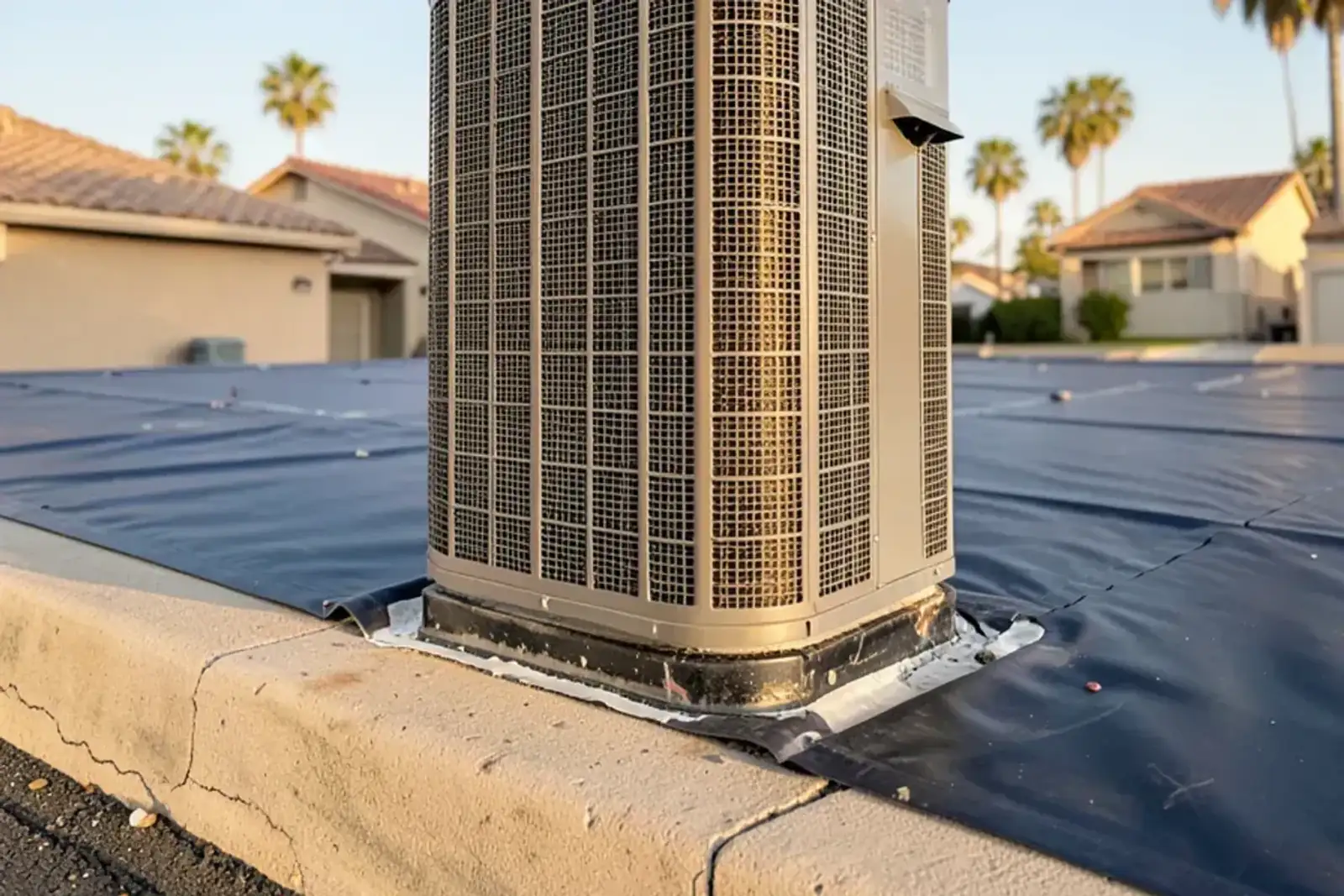
| Rooftop unit curb | Flashing gaps, split corners | Drip near ductwork or a light fixture |
| Pipe and conduit penetrations | Cracked boots, loose pitch pockets | Isolated drip, often on a clear line from the pipe |
Why parapet walls let water in
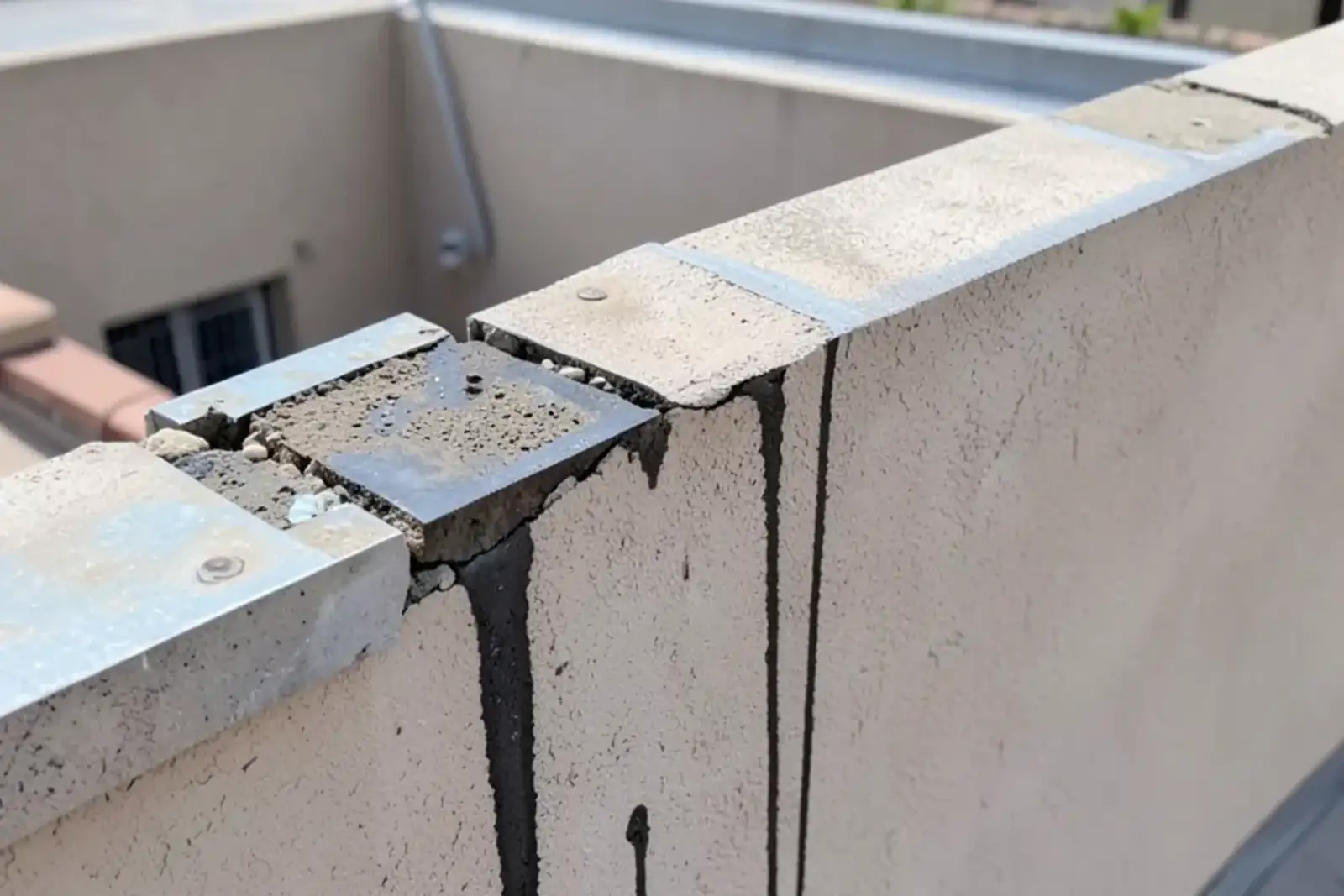
A parapet is the short wall that rises above the roof edge. It hides the roof from the street, but it also gives water two surfaces to attack: the top of the wall and the joint where the roof membrane climbs the wall's face.
The top is covered by coping, a cap of metal or masonry that should shed water outward. Over time the joints open, fasteners back out and the cap moves with the heat of the day. Rain then runs into the wall itself. On stucco or block walls, that moisture can travel a long way before it shows.
The base is the other weak point. Wall flashing is the strip of membrane or metal that turns up the wall and ties it to the roof. It depends on termination bars, sealant and the wall behind it staying tight. When any of those loosen, water slips behind the flashing and goes straight to the deck.
Roof drains, scuppers and ponded water
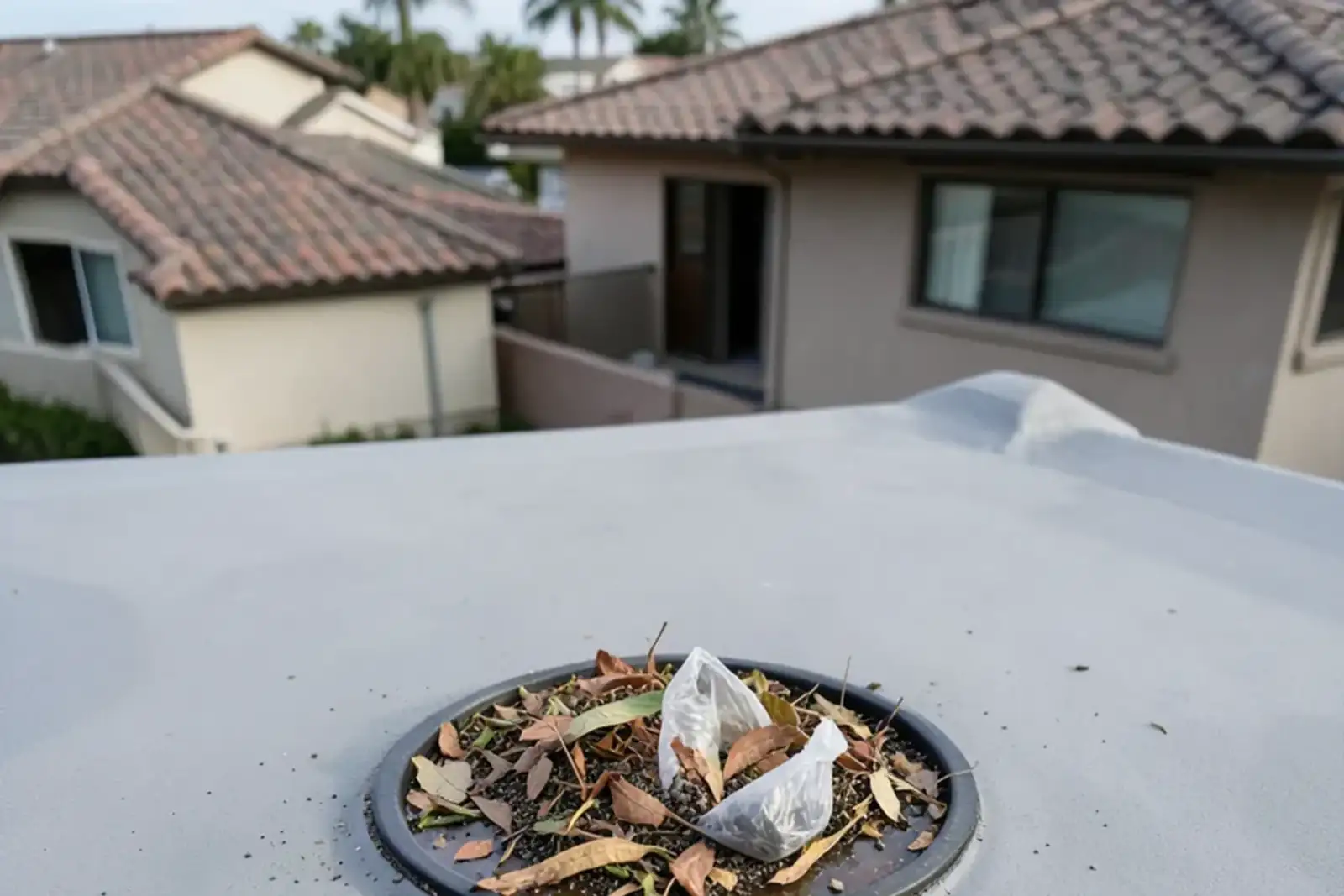
Drains do not leak much by themselves. The trouble is the water that cannot leave. A clogged drain or scupper, which is an opening through the parapet that lets water out, turns a low spot into a pond. The membrane is built to shed water, and standing water finds every flaw in it.
Check these after a storm:
- Water still standing 48 hours after rain
- Leaves, grit and trash packed around the drain strainer
- A cracked or loose drain bowl, or a gap around the clamp ring
- Staining on the wall below a scupper
Most ponding comes from the roof surface settling or from drains placed high. That is why clearing the drain is the first step, never the last.
How we trace a commercial leak before quoting
On a commercial roof we work from the inside out, because the stain is only the end of the trail. This is how we would assess a leak at your building:
- Get the history. When does it leak, in which weather, and what has been patched before?
- Walk the ceilings and walls. We note stain locations, damp insulation and any pattern along one wall.
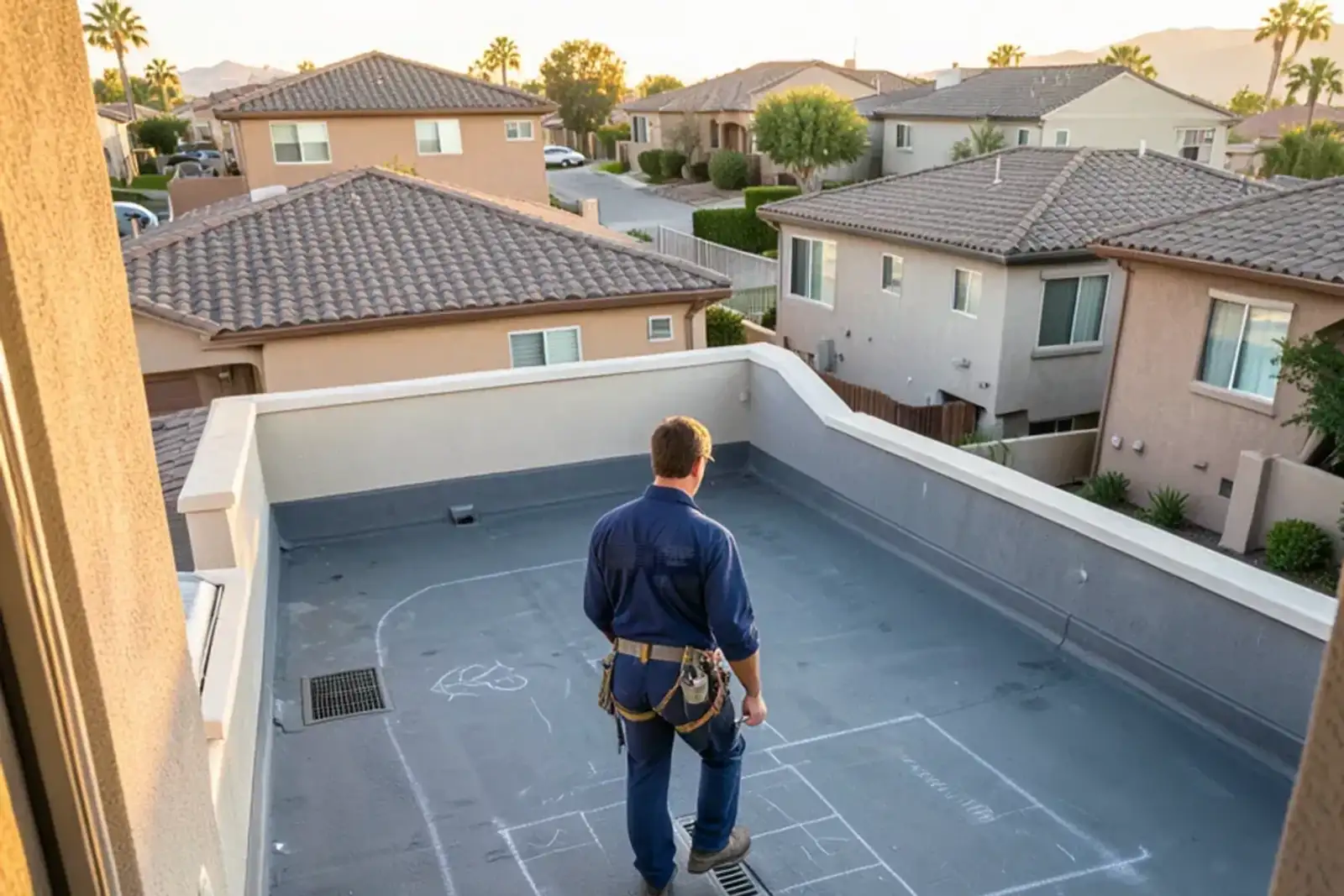
- Climb to the roof. We start on the high side of the stain and work uphill, checking coping, wall flashing and curbs first.
- Photograph every defect. You get the pictures, so the repair scope matches what we saw.
- Test when it is safe to. A controlled hose test on one detail at a time can confirm the entry point before anything is torn out.
- Write the scope. The estimate names each repair, each location and what is left alone.
Reviewers in Van Nuys mention drone photos during a job and a full water test after a leak repair. That is the standard we try to hold on any roof: find the source, show it, then confirm the fix.
Do you need a moisture survey on a leaking commercial roof?
Sometimes. A moisture survey maps where insulation under the membrane has gotten wet, which helps decide between a patch and a larger repair. Three methods are common: infrared imaging, which reads temperature differences left by wet insulation, capacitance meters and nuclear gauges, which read moisture at points on a grid. ASTM C1153 covers the infrared practice.
Know the limits. Infrared and capacitance both need a dry roof surface and suitable weather. Grid readings are extrapolated between points. Most important, a survey shows where insulation is wet, not necessarily where water entered, and the two can sit well apart. Roofs with parapet walls and busy perimeters are also harder to read by infrared at the edges.
So a survey works best as one tool alongside a walk of the details, not a substitute for it. On a small building with an obvious wall stain, a detailed look at the coping and flashing may answer the question for far less. On a large roof with repeated leaks, the survey can show whether the insulation is salvageable before anyone commits to a commercial roof replacement.
What working roofers say about parapet and drain repairs
Fixes at edges involve trade-offs worth hearing before you sign. Re-sealing coping joints is cheap and quick, but on a cap that moves with heat it often fails in a season, so rebuilding the joints or replacing the cap lasts longer and costs more. Raising or re-sloping a drain area fixes ponding properly, yet it means opening the roof. Coating over a leaking detail without repairing it first hides the problem for a while.
We would rather tell you which of the six details is the entry point and fix that one than quote the whole roof. When the field is sound, roof coating can follow the detail work. A routine of commercial roof maintenance catches clogged drains and open joints before they reach a tenant's ceiling.
What changes the cost of a commercial leak repair
We price in writing after the roof visit. The variables are:
- Number of failed details: one coping joint or a run of parapet wall
- Wet insulation: dry insulation stays, wet insulation is cut out and replaced
- Access: roof hatch, ladder or lift, and how far materials travel
- Wall type: stucco, block and metal copings each need different repairs
- Tenant and schedule limits: working hours, noise and where debris is staged
Repair a detail or replace the membrane
If the field of the roof is dry, firm and lightly worn, repairing the failed details is usually the right spend. A wet insulation core, widespread seam failure or repeated leaks in different spots argue for a bigger project, since patches only move the weakest point around.
Ask any contractor three questions: which detail is leaking, how do you know, and what happens to the other five like it? A repair estimate should also say whether tenants lose access, where debris is staged and how the work is protected overnight. Written terms should include any warranty, so ask for the warranty terms in writing.
If your building is in Commerce, we cover it from Van Nuys. See our Commerce service area for the area details, or call to set the earliest visit we can.
Next step for a leaking commercial roof
Gather the ceiling photos, the dates of each leak and any past repair records, then call Clear Shield Roofers at (209) 563-1278. Tell us the building type and where the stain shows, and we will say whether the next step is a roof visit, a survey or a quick look at one detail.
Quick answers
Why does my commercial roof leak at the parapet wall only after heavy rain?
Heavy rain pushes water sideways into small gaps that light rain never reaches, such as an open coping joint or a failed wall-to-roof flashing. Water then runs down inside the wall and appears at a ceiling or window line. Because the entry sits well above the stain, we start the search on top of the wall, not at the stain.
Can a clogged roof drain cause a leak by itself?
Yes. A clogged drain lets water stand against seams and flashings that were built to shed water, not to sit in it. Even a sound membrane will eventually let ponded water through. Clearing the drain stops the cause, but the area around it should be inspected afterward for seam damage, soft insulation or a cracked drain bowl.
Does a moisture survey find the exact spot a commercial roof leaks?
Not usually. Infrared, capacitance and nuclear surveys locate wet insulation, which can sit a distance from the entry point, and infrared is less reliable along parapets and edges. A survey tells you how big the wet area is. We would pair it with a walk of the details and a controlled water test before writing the repair scope.
Is a leaking parapet cap something a property manager can fix with sealant?
Sealant can buy a short stretch of time on a hairline joint, but it rarely lasts on a cap that moves with heat. If the cap is cracked, loose or missing sections, the joints and the wall flashing underneath need proper repair. A written scope should say which joints are being rebuilt and which are only being resealed.