
Roof Repair
Signs Your Roof Decking Needs Replacing
Roof decking needs replacing when it feels soft or springy underfoot, sags between rafters, shows dark rot or daylight from the attic, or will not hold fasteners. Decking is the board layer under your roofing. Here are the signs, what causes them and why the fix often waits for a tear-off.
- ★ 4.9 on Google · 69 reviews
- Same-day or next-day bookings
- Based in Van Nuys, CA
Published and updated November 3, 2026 · By the Clear Shield Roofers team, Van Nuys, CA
On this page
- Signs your roof decking needs replacing
- What each kind of deck damage tells you
- What we do when decking is bad during a tear-off
- Why you cannot roof over a soft deck
- Spot repair, over-boarding or a full re-deck? A roofer's trade-offs
- How attic moisture rots a roof deck from below
- A safe way to check your own roof deck
- Roof decking on postwar homes in San Fernando
- Getting your roof deck checked
- Common questions
Decking is the layer of boards or plywood sheets that sits on the rafters, under the underlayment and roofing. Everything above depends on it. When it goes soft, nails lose their grip and the roof loses its shape. These are the signs roof decking needs replacing, starting with the ones you can see from the ground.
If you suspect a failing deck, a structural roof repair assessment will separate a few bad boards from a deeper framing issue. Do not climb up to test it yourself.
Signs your roof decking needs replacing
Look for several of these together. One alone can have other causes.
- Sagging or wavy lines along the ridge or between rafters
- Soft, springy spots when someone presses the roof surface from a ladder edge
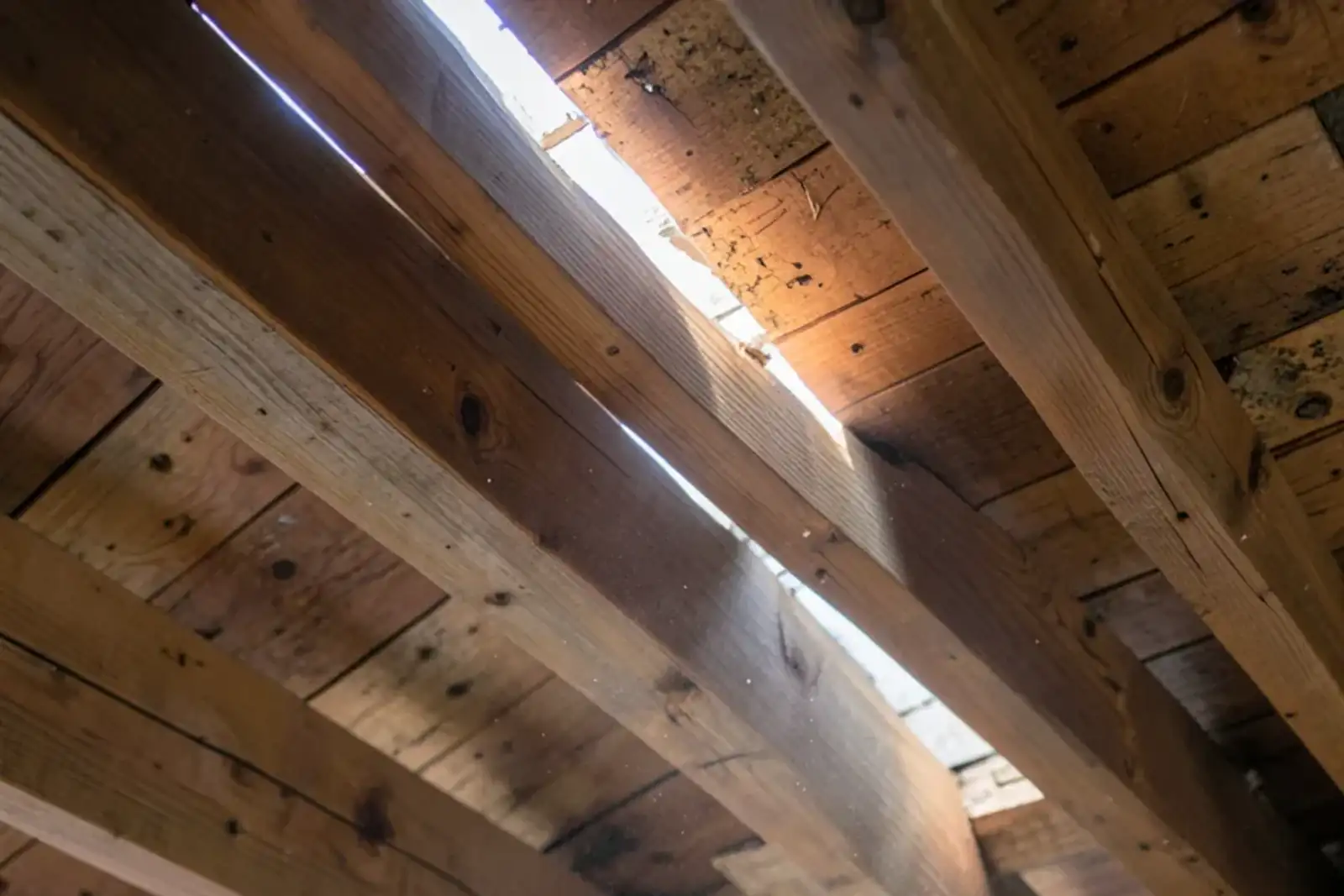
- Daylight through the boards from the attic
- Dark, crumbly or flaky wood on the underside of the deck
- A musty smell in the attic after rain
- Shingle nails backing out or shingles that will not lie flat
- Stained or sagging ceilings in the rooms below
What each kind of deck damage tells you
The cause decides how much of the deck is affected and what fixes it.
| Cause | What it looks like | Typical scope |
|---|---|---|
| Long-term leak | Dark rot around one penetration, valley or wall joint | A few boards or sheets near the leak |
| Attic moisture | Dampness and fungus across large areas of boards | Wider areas, plus venting fixes |
| Old skip sheathing | Gaps between spaced boards, daylight, weak nailing | Whole slope, often during a re-roof |
| Framing movement | Sag that follows rafters, not individual boards | Structural repair before the deck |
| Mechanical damage | Cracked boards from a fallen limb or heavy foot traffic | The damaged boards only |
What we do when decking is bad during a tear-off
The deck is only fully visible once the old roofing is off. That is when our crews mark soft areas, probe questionable boards with a tool, and photograph what they find. We want you to see the board before it is replaced and the price for it before the work happens. Reviewers describe hearing about a damaged board near the roof and plywood being replaced and explained first.
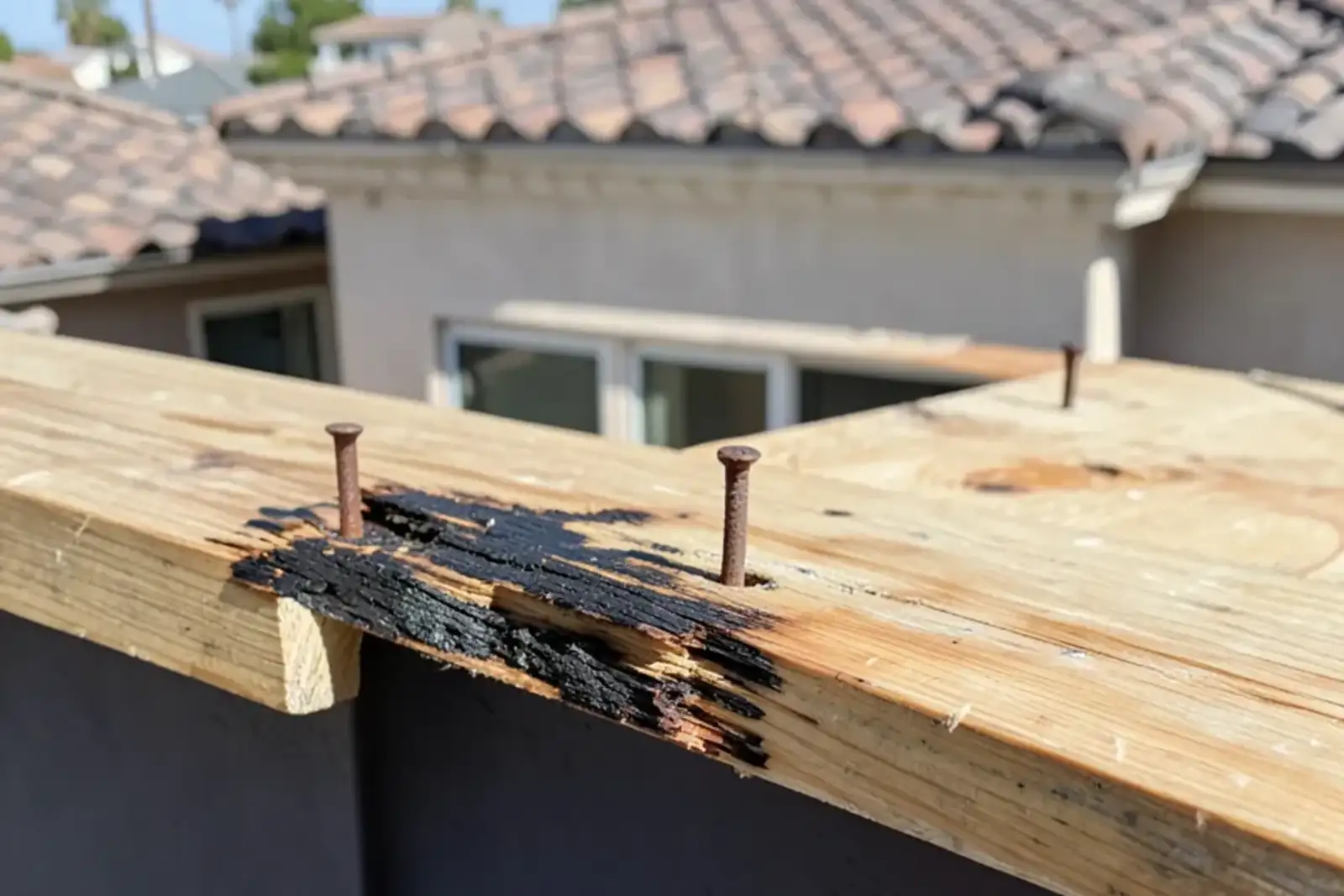
Replacement sheets must land on solid framing, not on the middle of a gap. Nail patterns follow the new roofing's requirements. Rusty old nails get pulled so they do not telegraph through the new surface. One Van Nuys customer describes a second pass with a magnetic roller for missed nails.
Why you cannot roof over a soft deck
California's residential code does not allow a new roof over a roof that is water-soaked or deteriorated. It also does not allow one over a roof that already has two applications, or over clay or cement tile. A soft deck therefore means a tear-off, not a quick overlay. That is also the chance to inspect the boards properly.
Spot repair, over-boarding or a full re-deck? A roofer's trade-offs
This is where honest roofers disagree with cheap bids. Decking cost is the line that moves most once a roof is open, and it is easy to understate.
- Spot replacement is the usual answer for rot that follows a leak path. It costs the least, but only if the rest of the deck is sound. We probe the boards around each bad sheet before calling it local.
- Over-boarding old spaced boards. On postwar skip-sheathed roofs, new plywood over the old boards gives a solid nailing surface without pulling every board. It adds weight and thickness at the edges, and it can trap moisture if the old boards are already wet.
- A full re-deck costs the most and takes the longest. It makes sense when most of a slope is soft, or when framing below needs work too.
- Deferring it. Some owners ask to skip a doubtful board to hold the price. We do not recommend it. A weak spot under new roofing shows up as a dip within a few seasons, and the whole slope may need to come up to fix it.
Whatever route fits, fix the water source first. New boards under the same leak or the same trapped attic moisture rot the same way. Our roof tear-off page explains why the deck is judged only once the old roofing is off.
What decking means for an older home's roof
Homes from the 1950s often combine thin spaced boards, old nail patterns and decades of patched leaks. On a roof like that, the deck is part of the quote, not a surprise. Ask how many sheets are assumed, how extra sheets are priced and whether spaced boards will be covered or replaced. Our older home roof replacement page covers how those decisions fit into a full re-roof.
How attic moisture rots a roof deck from below
Not all rot starts with a leak. Warm, damp air from bathrooms and kitchens rises into the attic, and when it cannot escape it condenses on the cold underside of the boards. Year after year that dampness darkens the wood and softens plywood glue lines. A bath fan that dumps into the attic instead of outside makes it worse.
That is why a deck replacement should come with a look at the vents. New boards under the same trapped moisture will fail the same way. Poor venting is something to fix at the same visit, not later.
A safe way to check your own roof deck
You can learn a lot without setting foot on the roof.
- Walk the yard and look at the ridge from several angles in low sun.
- Check the attic for light, stains, or damp wood.
- Look at the underside of the eaves for dark or flaking boards.
- Press on a stain in the ceiling below. Soft drywall is a sign.
- Take photos and send them over before the visit.
Roof decking on postwar homes in San Fernando
The median home in San Fernando was built in 1956, by Census ACS (2020-24) data, and 62 percent of homes are owner-occupied. Many postwar homes were built with spaced boards instead of solid sheets, which hold nails differently and let air and dust through. San Fernando is an independent city surrounded by Los Angeles, so re-roof permits go through its own building division rather than LADBS. San Fernando is an enclave inside the City of Los Angeles, with Sylmar, Pacoima and Mission Hills on its edges, so the housing around it shares the same postwar framing. We cover San Fernando from Van Nuys, about 8 miles and 20 minutes away, and the contract should name who pulls the permit.
Getting your roof deck checked
Tell us what you notice, such as a dip, a soft area or daylight in the attic, and send photos if you can. We will set the earliest visit we can, check the deck from the attic and the roof edge and explain what we find before any board is priced. Call (209) 563-1278 to book.
Quick answers
How do I know if my roof decking is rotted?
Look for soft or bouncy spots underfoot, dark stains or fungus on the underside of boards in the attic, and nails that no longer hold. A screwdriver should not sink into sound wood. Do not walk a roof you suspect is soft. Have it checked, because a missed spot can give way under a person.
Can I replace only the bad roof decking?
Often, yes. Rot usually follows a leak path, so the damage can be limited to a few boards or sheets near a penetration or valley. During a re-roof we mark the bad areas as the old roofing comes off. New sheets should be set over solid framing. Ask how the extra decking is priced before the work starts.
Does roof decking get replaced during every roof replacement?
Not every board. Sound decking stays, and bad sections get replaced once the old roofing is off. The deck cannot be fully judged until the tear-off exposes it, which is why quotes should say how replacement boards are handled. Skipped soft spots show up later as dips and loose shingles.
Will new roofing hold up if the old deck is only partly sound?
Not for long. Shingles and tile depend on the deck to hold fasteners and keep their shape, so a weak patch shows up as a dip or loose roofing within a few seasons. Mark and replace the weak areas while the old roofing is off, and ask your roofer to explain which boards they plan to change.
Does wet roof decking always have to be replaced?
No. Plywood or boards that got wet once and dried, with no softness, delamination or dark rot, can often stay. Wood that stays soft, crumbles or will not hold a nail has to go. We check by probing and by looking at the underside, and we show you the board before replacing it. Fixing the water source matters more than the wet itself.